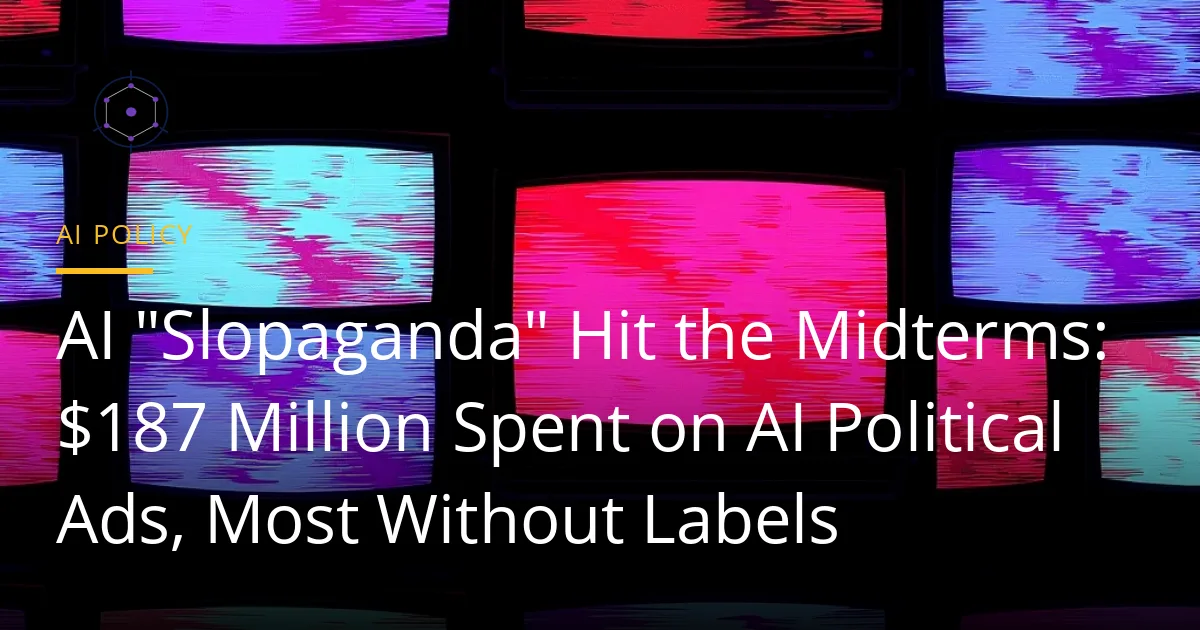
AI-generated political ads have gone from a rounding error to a major campaign tool in a single election cycle. Researchers at the Wesleyan Media Project found that $187 million was spent on nearly 300 ads generated or enhanced by AI before this week's US midterm elections, compared with less than $50,000 in 2024. Most of those ads carry no sign that AI was used.
The numbers
The Wesleyan Media Project's analysis, reported by CNBC and others, says the true total is probably higher, because many AI ads are not labelled. According to research findings cited by Crypto Briefing, only about 27% of the tracked ads contain any AI disclosure, while around 70% carry no disclaimer at all. A separate study by the Center on Technology Policy at New York University described an explosion of AI-generated political content, including memes and satire, calling it the most widespread use of AI content in an election so far.
Examples from both parties
Political "slopaganda," a term for AI-generated clips and images used in campaigns, has been used by candidates on both sides:
- Republican New York governor candidate Bruce Blakeman ran an ad with AI images of Democratic incumbent Kathy Hochul, including one gardening with an AI-generated version of New York City Mayor Zohran Mamdani. CNBC found it ran without a disclosure.
- In Texas, Republican Senate candidate Ken Paxton released an AI video of Democratic opponent James Talarico making controversial statements, with a three-second disclosure flashing in the middle, according to CNBC.
- Pennsylvania Republican Stacy Garrity's campaign posted an AI-generated video of Democratic Governor Josh Shapiro making damaging claims about himself.
- Democrat Scott Wiener, running in San Francisco, apologised for an AI ad attacking his opponent Connie Chan.
The Blakeman and Paxton campaigns had not responded to CNBC's requests for comment at the time of publication.
What the rules say
There is no comprehensive federal law on AI in political ads. Around 30 state laws vary widely, and the National Conference of State Legislatures counts 26 states with rules on political deepfakes, either requiring disclosure or banning them in a window before elections. A bill by Representative Yvette Clarke, the REAL Political Advertisements Act, would require AI disclosures on political ads, but it has not become law. Meta, Google and X each require some form of labelling or legal compliance. YouTube says it applies prominent labels to realistic AI content and requires advertisers to disclose synthetic people or events. Tests by the Brennan Center found that major AI models can often still be pushed into producing misleading election content.
Why it matters
The concern is less any single ad than the wider effect: when realistic fake images and videos become routine, voters can struggle to tell what was really said, and real footage can be dismissed as fake. The spending growth suggests campaigns of every stripe see value in the format. Whether disclosure rules catch up before the next election is an open question.
How to protect yourself
- Pause before sharing a shocking clip, and look for the original source or a report from a trusted news outlet.
- Check the candidate's official channels to see whether they actually said it.
- Look for labels, but do not assume that the absence of one means a video is real.
Sources: CNBC (3 November 2026), citing the Wesleyan Media Project; New York City News Service; Crypto Briefing; Daily Kos; The Hill, via AOL.