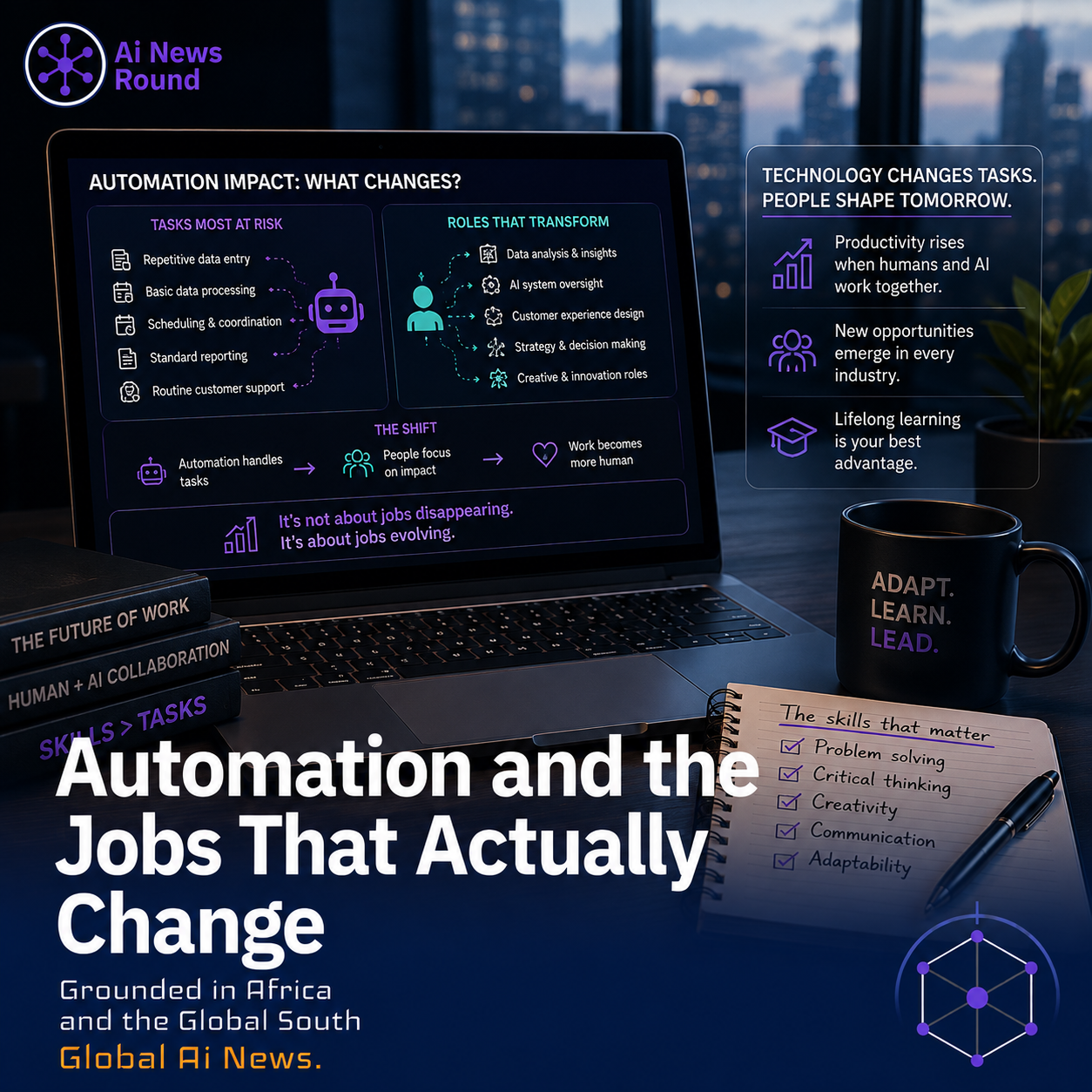
Predictions about AI and employment usually count jobs, which is the wrong unit. Occupations are bundles of tasks, and automation arrives task by task. That distinction changes the picture considerably.
Which tasks go first
Ones that are repetitive, well-documented, verifiable, and where a wrong answer is cheap to catch. Drafting a first version of routine text. Summarising a long document. Converting between formats. Producing boilerplate code. First-line triage where a human confirms anything unusual.
What resists is not necessarily complex. It is work requiring physical presence, accountability that must sit with a person, relationships, or judgement in genuinely novel situations. A great deal of skilled manual work is far harder to automate than a great deal of skilled desk work, which inverts the assumption most people started with.
The uncomfortable middle
When the routine parts of a job are automated, what remains is the difficult parts, continuously. That is not obviously an improvement in working life. Roles that lose their easy tasks can become more stressful rather than easier, and the productivity gain is often captured as a headcount reduction rather than as breathing room.
The part that is a policy choice
Whether a productivity gain becomes shorter hours, better pay, lower prices or higher margins is not determined by the technology. It is determined by bargaining power, labour law and market structure. Framing the outcome as inevitable removes from view the several points at which somebody decides.
For an economy where a large share of employment is informal, the first-order effects may be smaller than in heavily white-collar economies — and the second-order ones, transmitted through outsourcing and remote work markets, may be larger.