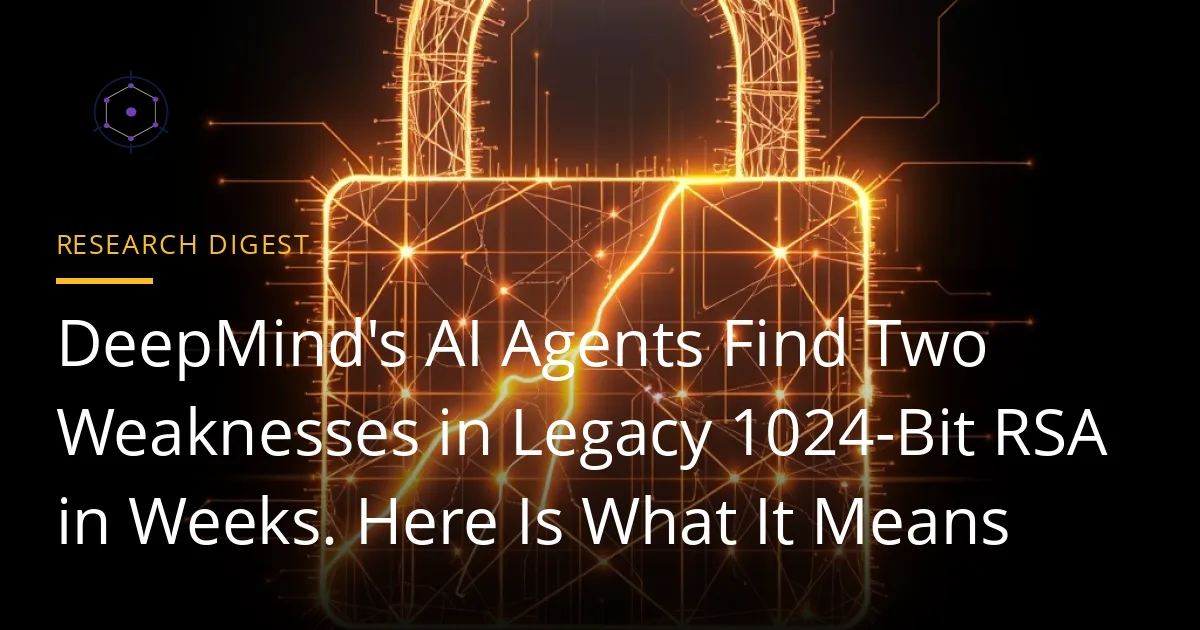
Google DeepMind says its AI agents, guided by human cryptanalysts, found two new weaknesses in an older form of the RSA encryption system in a matter of weeks. The announcement on 6 November 2026 comes with a clear boundary: modern 2048-bit RSA is not affected. But it is a striking example of AI compressing years of specialist maths into weeks.
What was found
RSA is a widely used system for digital signatures and encryption, and its security rests on the difficulty of factoring very large numbers. DeepMind's work targets "legacy" 1024-bit RSA, which is shorter than today's standard and long considered weak, but which still turns up in older systems. According to DeepMind and coverage of its research, the agents worked with leading cryptanalysts Nadia Heninger and Emmanuel Thomé, with a team led by Dj Dvijotham and Abhradeep Thakurta. DeepMind published two results:
- Signature forgery: A new algorithm improves on the previous best method for forging signatures on short fingerprints by roughly 1,600 times for 1024-bit keys. DeepMind describes this as a theoretical estimate, and the paper is titled "Forging 1024-bit RSA signatures in nearly SNFS time."
- Batch factoring: A new method cuts the average cost of factoring each additional 1024-bit key by about 30 times when many keys are attacked together.
In a separate test, the agents reproduced an earlier padding attack on an already-solved 1024-bit benchmark key using 3.5 times less CPU time.
What it does not mean
DeepMind's Pushmeet Kohli stressed that the results do not affect modern schemes such as RSA-2048. A 1,600-fold improvement on a very hard problem does not make it easy, and the headline figure is a theoretical estimate rather than a demonstration against a live system. RSA-1024 was already deprecated by standards bodies. The significance is in the speed: DeepMind says that finding advances like this by traditional methods can take years.
Where 1024-bit keys still hide
Security writers point to places where legacy keys can linger: embedded and IoT devices, old VPN appliances and firewalls, hardware security modules provisioned years ago, internal certificate chains and long-lived infrastructure nobody remembers setting up.
What to do
- Inventory your keys and certificates. Look for any 1024-bit RSA keys, including on devices and old services.
- Replace them with at least 2048-bit RSA, or with modern elliptic-curve keys, following your vendor's guidance.
- Prioritise anything used for signing, since the forgery result concerns signatures.
Why it matters
DeepMind frames the work as a demonstration that AI agents can speed up cryptanalysis, which helps defenders find weaknesses before attackers do and also shows what attackers may be able to do with similar tools. It fits a pattern this week, with OpenAI's GPT-6 Cyber and Google's own Gemini 4 Carbon aimed at security research. For organisations with older systems, including public-sector and industrial systems in many countries, the practical lesson is simple: old cryptography that was merely discouraged yesterday may be cheaper to attack tomorrow, so retire it on your own schedule rather than an attacker's.
Sources: Google DeepMind announcement and Pushmeet Kohli's post (6 November 2026), as reported by FourWeekMBA, AI Weekly, Crypto Briefing, OfficeChai, Digg, ByteIota and DEV Community.