Streamlining Underwater Target Recognition
Recent research evaluating artificial intelligence systems for automatic target recognition in synthetic aperture sonar data has challenged the assumption that complex, multi-stage training pipelines are necessary for high-accuracy performance. By adapting pre-trained DINOv3 Vision Transformers to process acoustic signals, researchers tested whether parameter-efficient fine-tuning methods could bridge the substantial domain gap between natural optical imagery and underwater acoustic propagation.
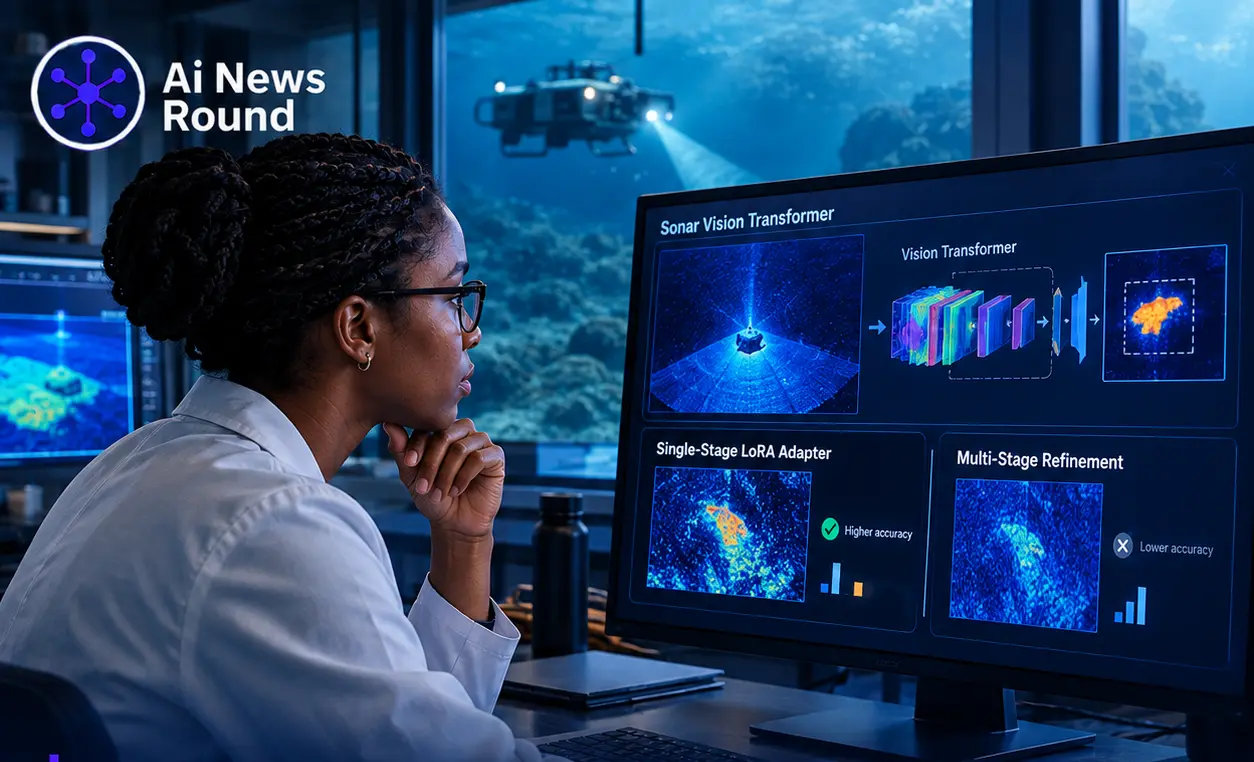
The assessment compared a single-stage domain adaptation approach against an elaborate three-stage pipeline that added hard-negative mining and Supervised Contrastive Learning to the initial training phase. Rather than yielding cumulative improvements, empirical evaluations on at-sea sonar data revealed that the secondary and tertiary refinement stages provided virtually no statistical performance gains over the initial adaptation step.
Performance Metrics and Parameter Efficiency
The application of Low-Rank Adaptation to the attention layers of the Vision Transformer backbone accounted for almost the entire performance gain observed in the experiments:
- Inserting rank 4 adapters while keeping the core transformer backbone frozen increased the Area Under the Precision-Recall Curve from 0.300 to 0.679.
- This threefold improvement in classification accuracy was achieved by training only 0.26 percent of the model's total weights.
- Subsequent hard-negative mining focused on acoustic mimics, such as natural rock formations and sediment clutter, yielded a slight performance reduction within the noise margin.
- Additional contrastive geometric regularization failed to outperform matched control runs, proving that the initial adaptation stage had already successfully structured the target-clutter decision boundaries.
Practical Implications for Edge Deployment
These findings hold major operational benefits for cloud systems engineers, naval defense developers, and embedded software architects building processing frameworks for autonomous underwater vehicles. By demonstrating that a single, targeted adaptation stage is fully sufficient for domain transfer, the research highlights a way to bypass computationally expensive training pipelines:
Reduced Storage and Compute Costs
Freezing the vast majority of weights eliminates the need to maintain, store, and distribute multiple full-model checkpoints for specialized sonar environments.
Simplified Deployment Pipeline
Skipping hard-negative mining curricula and contrastive loss optimization simplifies software orchestration and reduces training time, allowing faster iterations for field deployment on resource-constrained hardware.